
Introducing RUBY: State-of-the-Art Potency Prediction Across Discovery Regimes
It is a truth universally acknowledged, that a drug hunter pursuing a tough target, must be in want of a better potency model. Potency may not be sufficient for your development candidate, but it certainly is necessary. Unfortunately, predicting it is notoriously challenging, a "holy grail" type problem in AI. And while LLMs might be able to riff on Pride and Prejudice, good luck using them to predict binding affinity.
In hit ID for a novel target, you need to triage a billion-molecule library into a few hundred to acquire and test. In lead optimization, you need to use the data that you've generated so far to intelligently choose from the millions of analogs you could draw down to the dozen you have bandwidth to synthesize.
Computational approaches tend to be focused on either one of these regimes, but not both. Free-energy methods are accurate within a series, but too expensive for screening. Ligand-based QSAR approaches are low-cost, but require having enough program data to start and fail to generalize to new scaffolds. Docking is in between, but the scoring function remains limited and it struggles to account for protein motion.
We’re publishing the technical report on our potency prediction approach, Ruby, along with audited training data, GenesisPotency-2026, under a public CC BY-SA 4.0 license today.
Using implicit rather than explicit structural representation
Ruby uses our cofolding foundation model, Pearl, at its core. The typical route for structure-inspired potency prediction is to generate an explicit pose and score it. However, pose generation is costly, often inaccurate depending on the method, and limits the scale of compounds that can be virtually screened.
Rather than generate a pose and then separately score it, the trunk of Pearl outputs a representation of all relationships between protein and ligand tokens. Ruby directly consumes that pair representation and can make a potency prediction without generating an explicit binding pose for each compound. Inputs are protein sequence, ligand SMILES, and (in the hit ID work that follows) no other information aside from that.
Not explicit generating poses has two advantages. One is that the biggest part of the inference budget for diffusion-based cofolding is dropped, enabling large-scale virtual screening-scale usage. The other is that by dropping it the user can turn a dial where the same model checkpoint works at four inference efforts (Low, Medium, High, Max) spanning more than two orders of magnitude of compute, so the same model can be used to triage a million compounds and to rank carefully within a series.
Hit identification
We ran Ruby on seven public screening sets (three from large-library docking campaigns and four from the CACHE challenges), re-ranking the real compounds they actually sent in for testing.
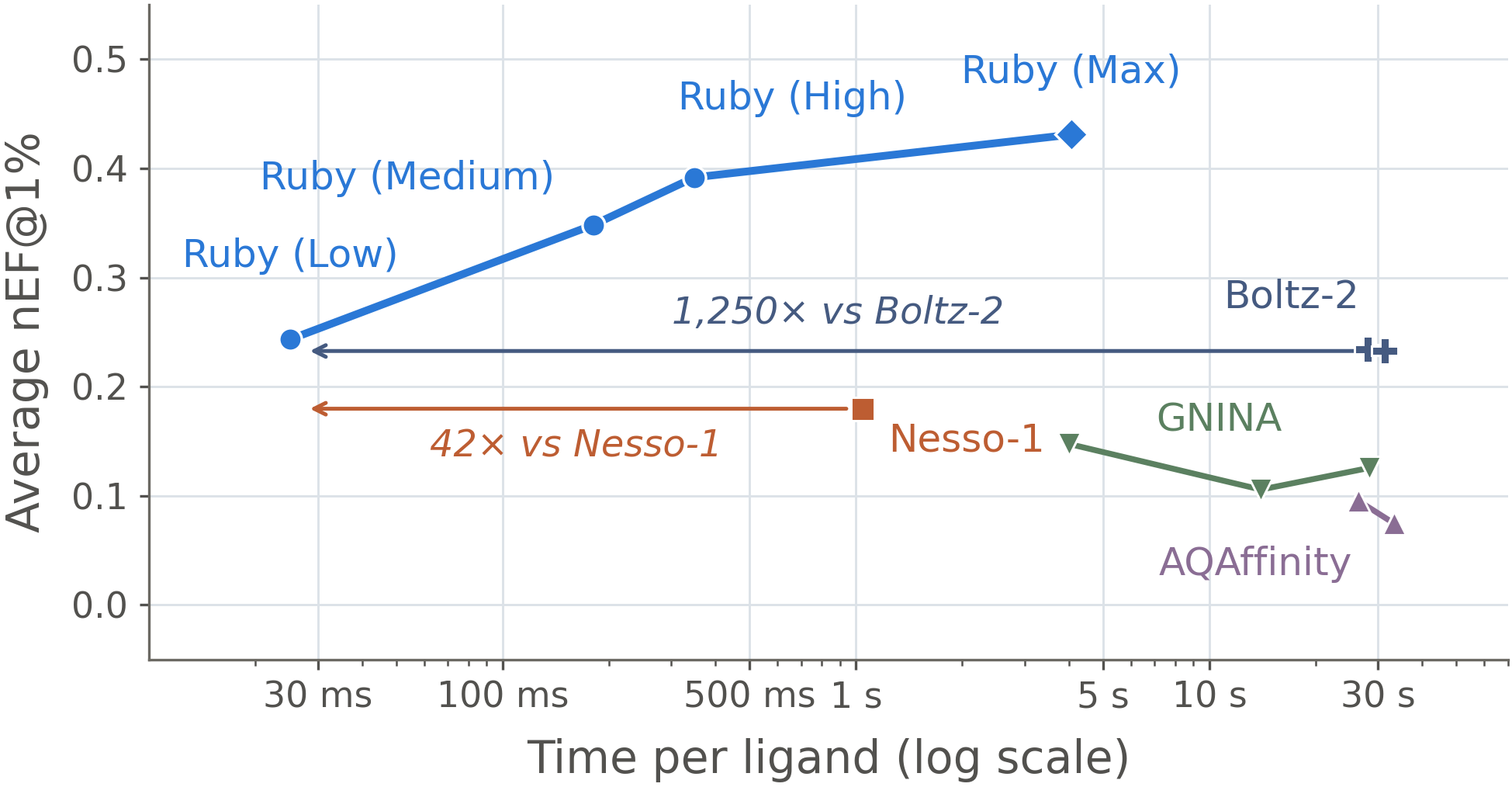
More than any other regime, hit ID cares about enrichment within some computational budget because the molecular spaces we can explore are very, very large. At its lowest setting Ruby scores a ligand in 25 milliseconds and enriches slightly better than Boltz-2 does in about thirty seconds (1,250x slower). Raising the effort to Max at 4 s/ligand roughly doubles the enrichment to 0.43, ahead of every method we evaluated.
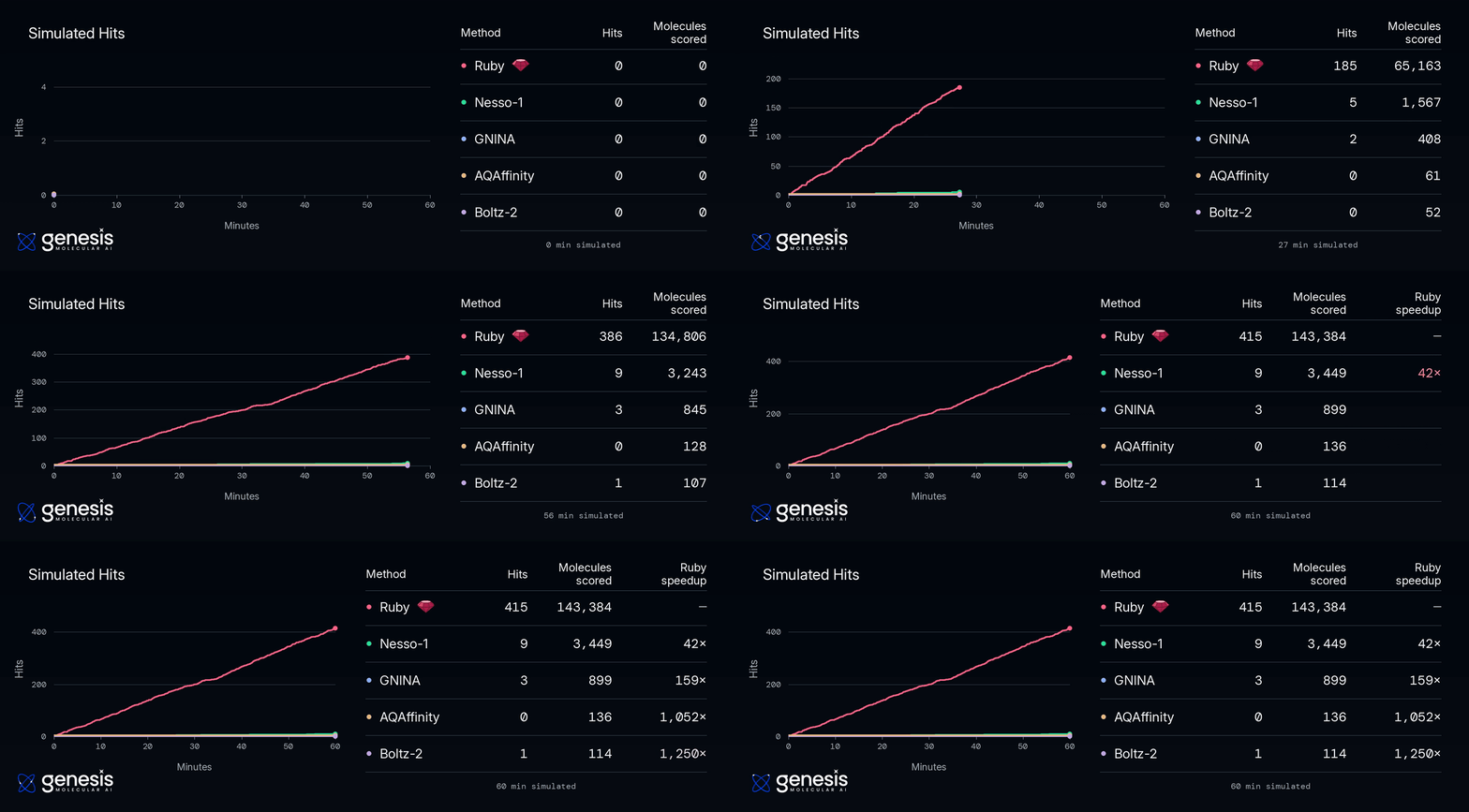
The same comparison, as throughput: how many compounds each method scores in a fixed window on a single GPU, at the settings used in the hit identification evaluation above.
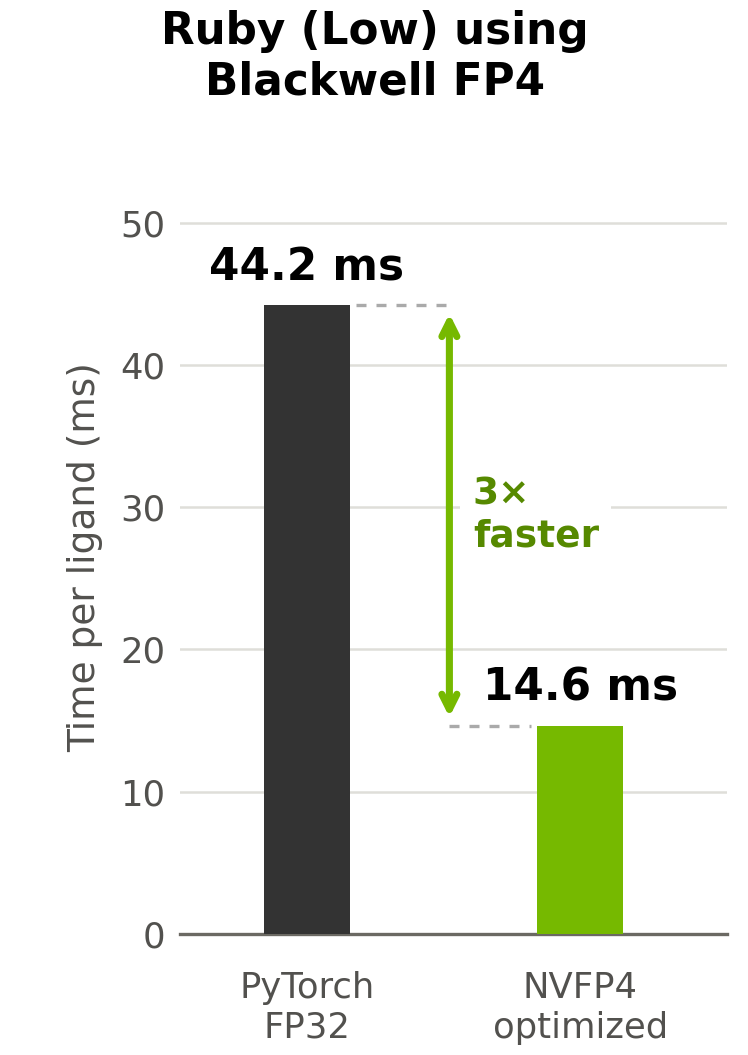
We got there working with Nvidia, optimizing Ruby’s low-effort inference path for Blackwell chips. Moving to NVFP4 kernels with Transformer Engine, cuBLAS BF16x9, CUDA Graphs and cuEquivariance attention cut warm inference on an example target, from 44 to 15 milliseconds per ligand at identical model effort, roughly threefold more throughput from the kernel work alone.
Public potency benchmarks
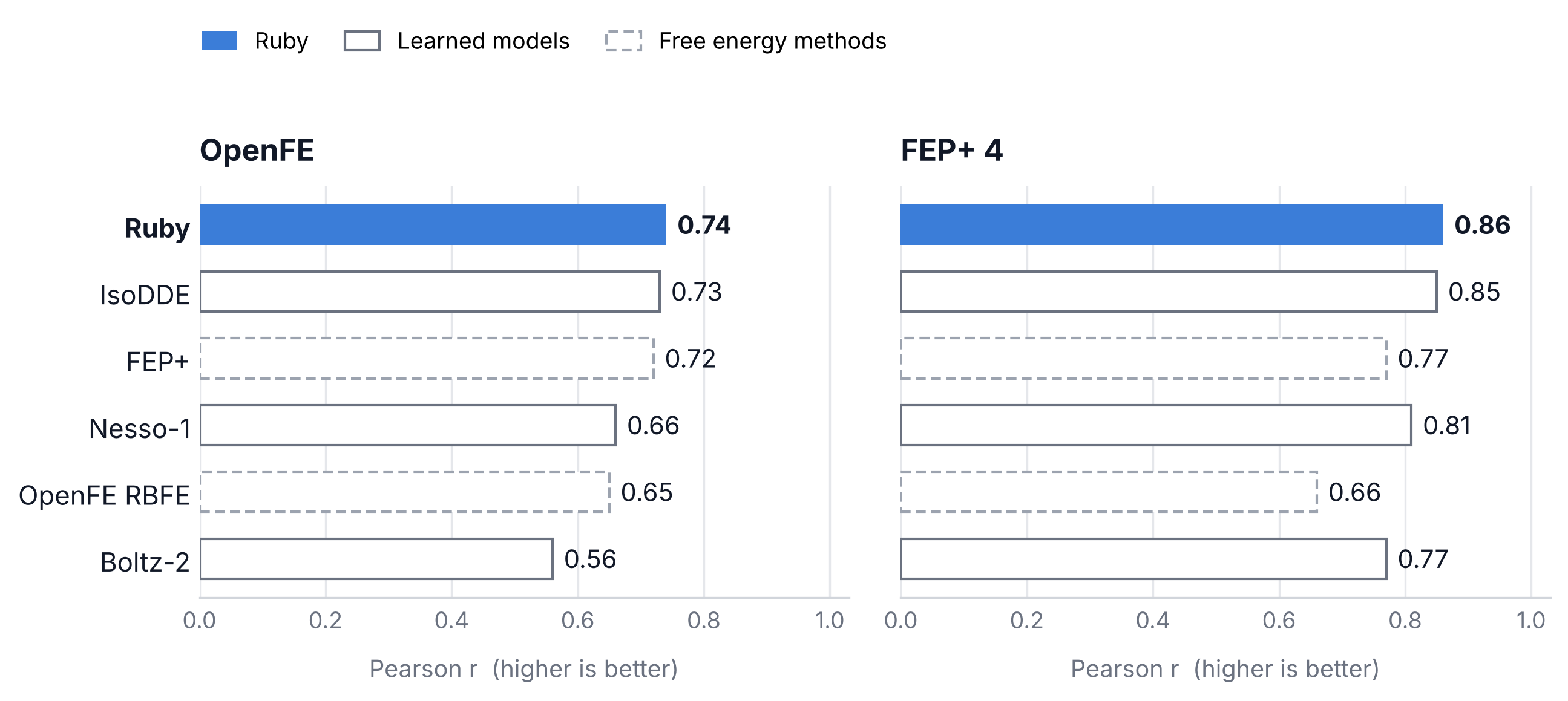
We compared zero-shot Ruby on four public benchmarks (OpenFE, CASP16, FEP+ 4, and OpenBind) and found that it achieves the best average correlation on every one.
Ruby edges out the best closed AI model, IsoDDE, and also significantly outperforms Nesso-1, Boltz-2, and every other open & closed model we could find. It also equals or exceeds the accuracy of free-energy methods on OpenFE and FEP+ 4, while being many orders of magnitude faster.
On real programs
Public benchmarks are necessary but not sufficient. Real programs are where performance actually matters.
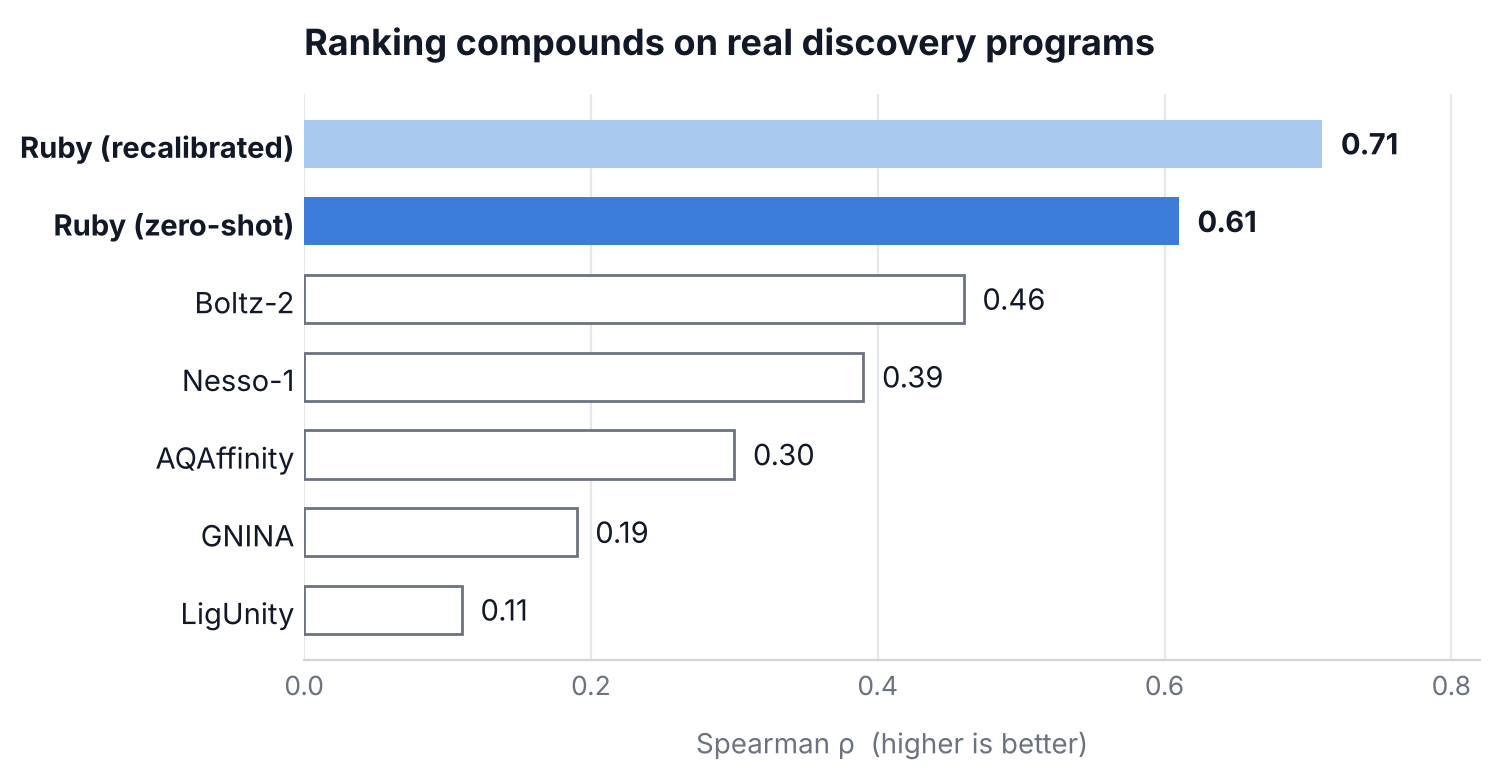
Without any prior data from these specific assays, Ruby achieves a robust average Spearman correlation of 0.61 in a zero-shot setting across 8 assays over 5 diverse programs. That is a high bar; for reference, for many drug discovery campaigns, the Spearman correlation between two different experimental assays of the same target can be 0.70 or even lower! Ruby’s out-of-the-box accuracy substantially exceeds all other benchmarked models in this tough industry setting. Recalibrating Ruby to learn from earlier within-assay measurements improves it further.
More, better data with GenesisPotency-2026
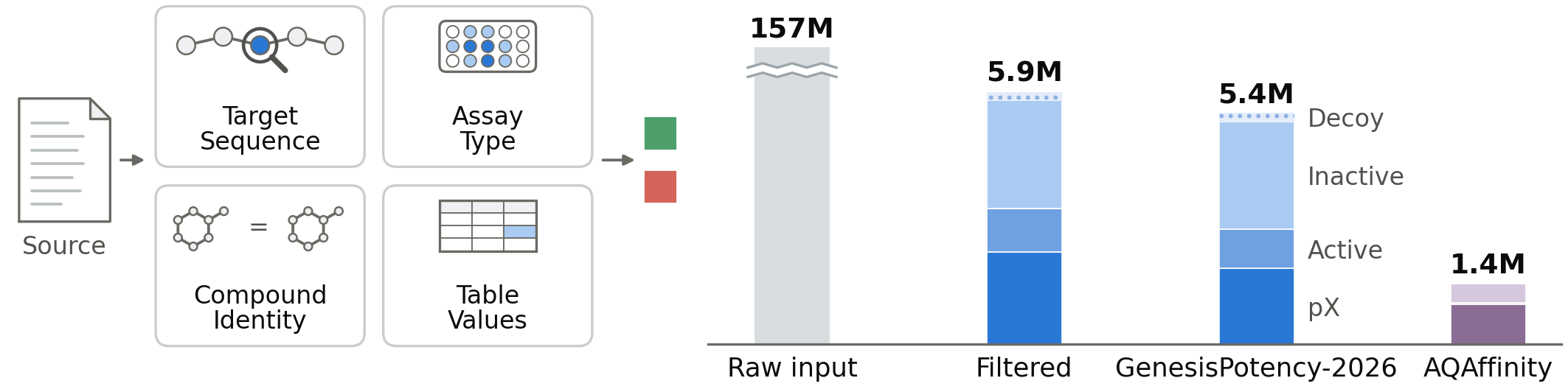
Alongside the technical report we’re releasing GenesisPotency-2026, a public-source portion of Ruby’s training data, under a CC BY-SA 4.0 license. It contains 5.6 million rows (roughly four times the size of AQAffinity’s released training set, the largest comparable public set we’re aware of) published with row-level provenance and our audit annotations attached. Ruby itself is trained on this corpus together with other public and proprietary data.
Public potency data is messier than its reputation. Records are recycled between databases, so when two sources agree it rarely means independent confirmation; more often it means the same transcription error traveled twice.
We assembled the corpus from ChEMBL 37, BindingDB release 202607 and an October 2025 PubChem HTS pull: around 157 million rows before filtering. Most of that volume is high-throughput screening data, and the bulk of the reduction to 5.6 million comes from ligand- and assay-eligibility filters, grouping by source document, target and readout, and a cutoff restricting the set to measurements dated before January 2023.
We then audited the source documents themselves: assay-level checks of target identity, experimental context, endpoints and units, followed by compound-level checks on up to 15 sampled compounds per document. Of 2.51 million ChEMBL and BindingDB records in scope, 1.24 million belonged to documents we could actually read. Across 8,995 documents and 115,235 sampled compounds, the audit retained 699,742 entries unchanged, marked 52,575 for correction and 486,600 for removal.
Some of what the audit found is worth seeing. In one patent, 885 measurements of FLAP inhibitors had been attributed to flap endonuclease 1, an unrelated protein, in both databases independently. In another, 10 of 15 sampled structures carried potencies belonging to different compounds.
We think the field is better served by arguing about this in the open than by every group quietly maintaining its own private corrections.
What’s next
Each discovery program is a chain of high-stakes bets on the future, made to create a novel, patentable compound that can be advanced into the clinic to improve patients’ lives. By definition, each program has to explore uncharted territories of chemical space. Chemists rarely lack ideas, but they will always be constrained by the ability to synthesize only a small number of compounds at a time, and each synthesis choice must be made before potency can be verified experimentally.
That constraint is not going away with Ruby. The difference is that our models instill more confidence in each synthesis bet, even in more creative chemical and target spaces.
What to make remains the human drug hunters’ choice, but we want them to be the most informed drug hunters in the world.
Join Us
Opportunities in AI and Physics Research
In The News
